Here’s how many applied to the hackathon...
I want to share how many people applied to our Nepal-US Hackathon 2026 below…
But first, let me quickly run down what this newsletter will look like every week:
One leadership conversation we hosted,
What’s coming up next this month, and
A behind-the-scenes look at what we’re building and why
What a Data + AI Leader Thinks the Future of Tech Careers Will Look Like
Sudeep Regmi, Head of Enterprise Data Management & Innovation at Takeda talks about how tech careers evolve, what AI will actually change, and how professionals can position themselves for leadership.
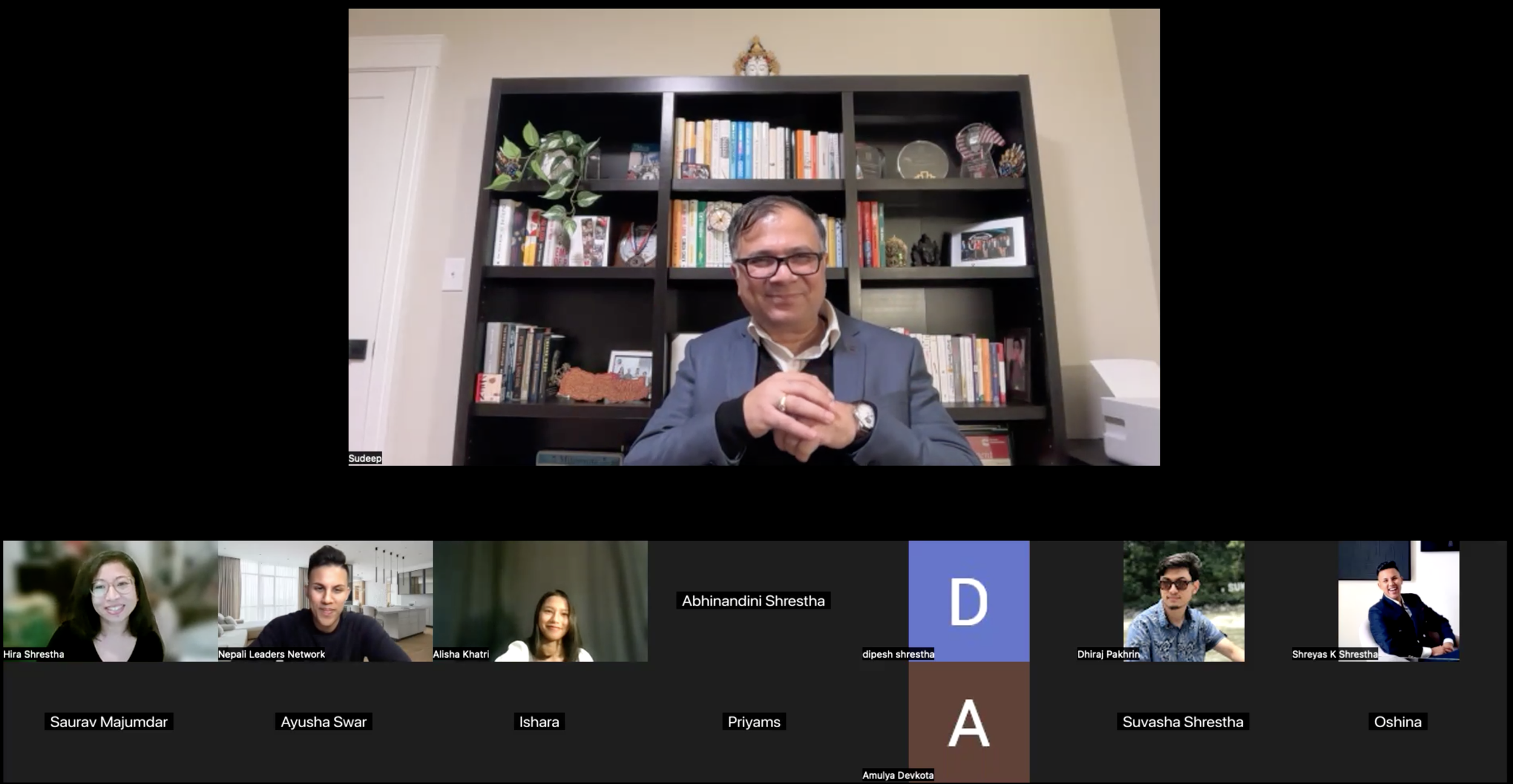
1) Your career started before the AI boom. When did you decide to move into data and AI?
When I began my career, the biggest trend wasn’t AI — it was ERP systems like SAP and Oracle. Around 2004–2005, my manager asked me to help on a data warehouse project. At the time, I enjoyed the work but didn’t emphasize it much because ERP seemed like the stronger career path. Everything changed around 2012 when digital transformation became a priority and data became central to decision-making inside organizations. That shift pushed me to fully lean into the data side of the industry. The key lesson is that careers often move forward when you recognize where the industry is heading and commit early before the shift becomes obvious to everyone.
2) How will AI change tech careers over the next few years?
Many roles that focus purely on writing code will evolve. With AI copilots, low-code platforms, and agent-based systems, engineers will increasingly review, orchestrate, and integrate systems rather than write every line manually. At the same time, new roles are emerging across organizations, such as AI product managers, AI architects, and governance specialists responsible for ensuring AI systems are implemented responsibly. The professionals who thrive will be those who understand not only the technology but also the business problems AI is meant to solve.
3) What separates professionals who grow into leadership roles from those who remain stuck?
Many professionals stay focused on the tasks in their job description, while leaders expand their scope. They look for opportunities to solve problems beyond their assigned responsibilities and develop influence across teams. One point that stood out during the conversation is that leadership is often about how well you can influence people — influencing your team to do their best work, collaborating effectively across functions, and aligning stakeholders around decisions. Technical expertise helps, but the ability to move people and ideas forward is often what determines long-term leadership growth.
4) You emphasized storytelling. What does storytelling mean in a data or AI career?
Storytelling means translating technical work into business outcomes. Early-career professionals often describe what they built — a model, a dashboard, or a piece of code. But decision-makers care about what changed because of that work. When you can clearly explain how your work improved efficiency, reduced cost, increased productivity, or solved a real problem, your work becomes meaningful to the organization. That shift from explaining tasks to explaining impact is a key leadership skill.
5) What advice would you give someone early in their career preparing for the future of AI?
Focus on adaptability and continuous learning. Technology changes quickly, and tools that are relevant today may not even exist in a few years. Instead of tying your career to one specific technology, build strong fundamentals in problem-solving, domain understanding, and learning how to learn. The ability to continuously learn, unlearn, and relearn will be far more valuable than mastering any single tool.
Key Takeaways
Career growth often comes from recognizing industry shifts early and adapting.
AI will move tech roles from pure coding toward orchestration, integration, and governance.
Leadership is heavily driven by influence — across teams, stakeholders, and organizations.
Professionals who communicate impact instead of tasks stand out faster.
Long-term success depends on the ability to continuously learn, unlearn, and adapt.
Join Our Free Community To Watch Full Talk
Upcoming Events
1. Leadership Speaker Series ft. Dr. Smeeta Shrestha, Research Strategist, Genomics & Human Health
🗓 Date: Wednesday, March 4
⏰ Time: 7:00 PM – 8:00 PM ET
📍 Location: VirtualDr. Smeeta will break down “How to Get Started in Research as a Student or Early-Career Professional.”
What participants will learn:
- How to take your first steps into research, even without prior experience
- How to find mentors, labs, or projects to get involved in
- What research really looks like beyond classes and textbooks
- How research skills open doors across academia, industry, and policyAbout Smeeta Shrestha
Dr. Smeeta Shrestha is a research strategist with over 20 years of experience in genomics and human health research. She has authored more than 25 peer-reviewed publications in leading journals, including Nature Genetics, Nature Communications, Clinical Epigenetics, and Microbiome, and has contributed to large international research collaborations spanning over five countries.
She currently works as a Research Strategist and was most recently a Senior Research Fellow at the Lee Kong Chian School of Medicine, where her research focused on linking gut health, metabolism, and disease using integrative genomics, transcriptomics, metabolomics, and metagenomics approaches. She has previously held academic and research positions at institutions including Nanyang Technological University (Singapore) and the Centre for Cellular and Molecular Biology (CSIR, India). Dr. Shrestha has recently joined Dhulikhel Hospital, Kathmandu University Hospital, as a molecular geneticist, with a vision to establish a medical genetics clinical service alongside teaching and research, contributing to the advancement of genomic medicine capacity in Nepal. She also brings extensive experience mentoring undergraduate and graduate students and early-career researchers across academic and translational research settings.
Behind The Scenes
Last week I shared that the Nepal–US Hackathon 2026 had crossed 130+ applications.
That didn’t last long.
As of today, we’re sitting at 600+ applications from Nepalis around the world.
When we set the internal goal, we picked 500 mostly because it sounded bold and slightly unrealistic.
Now we’re past it with a few days still left before applications close.
Behind the scenes, this week has mostly been the unsexy work.
Another cool update: almost 40 organizations are now part of this effort, including Nepali student associations across the U.S. and several community organizations supporting the initiative.
It’s starting to feel bigger than just an idea.
Applications close March 9, so if you (or someone you know) wants to participate, there’s still a few days left.
Apply here:
[Check out Nepal–US Hackathon 2026]
Community Update
Our free community on Circle has grown to almost 600 members.
Starting in April, the community will become application-based.
It will still be free, but we’ll review new members before approving them. The goal isn’t to have everyone in there, it’s to build a high-quality space with people who actually want to participate and contribute.
For those already inside:
If you haven’t fully updated your profile, please do so by the end of March.
After that, we’ll remove incomplete profiles so the community stays active and valuable for the people who are genuinely engaged as we re-architect the platform for increased value.
Anyways, now that you’re officially caught up, you can check out our website to see the full breakdown of what Nepali Leaders Network is, where we’re going, and the long-term vision behind this whole thing.
And if you haven’t already, join our free community — it’s the hub for everything: events, fellowships, networking, and all the opportunities we’re rolling out next.
More soon,
Shreyas K. Shrestha
Founder, Nepali Leaders Network
P.S. If you made it this far, you’re a real one. These newsletters might be my favorite way to stay connected to 1,100+ of you. See you back in a week!
