Did we just go GLOBAL?!
I want to share some CRAZY updates regarding Nepal-US Hackathon 2026…
But first, let me quickly run down what this newsletter will look like every week:
One leadership conversation we hosted,
What’s coming up next this month, and
A behind-the-scenes look at what we’re building and why
How a Nepali Founder Built a $15M E-Commerce Business (And What Most Beginners Get Wrong)
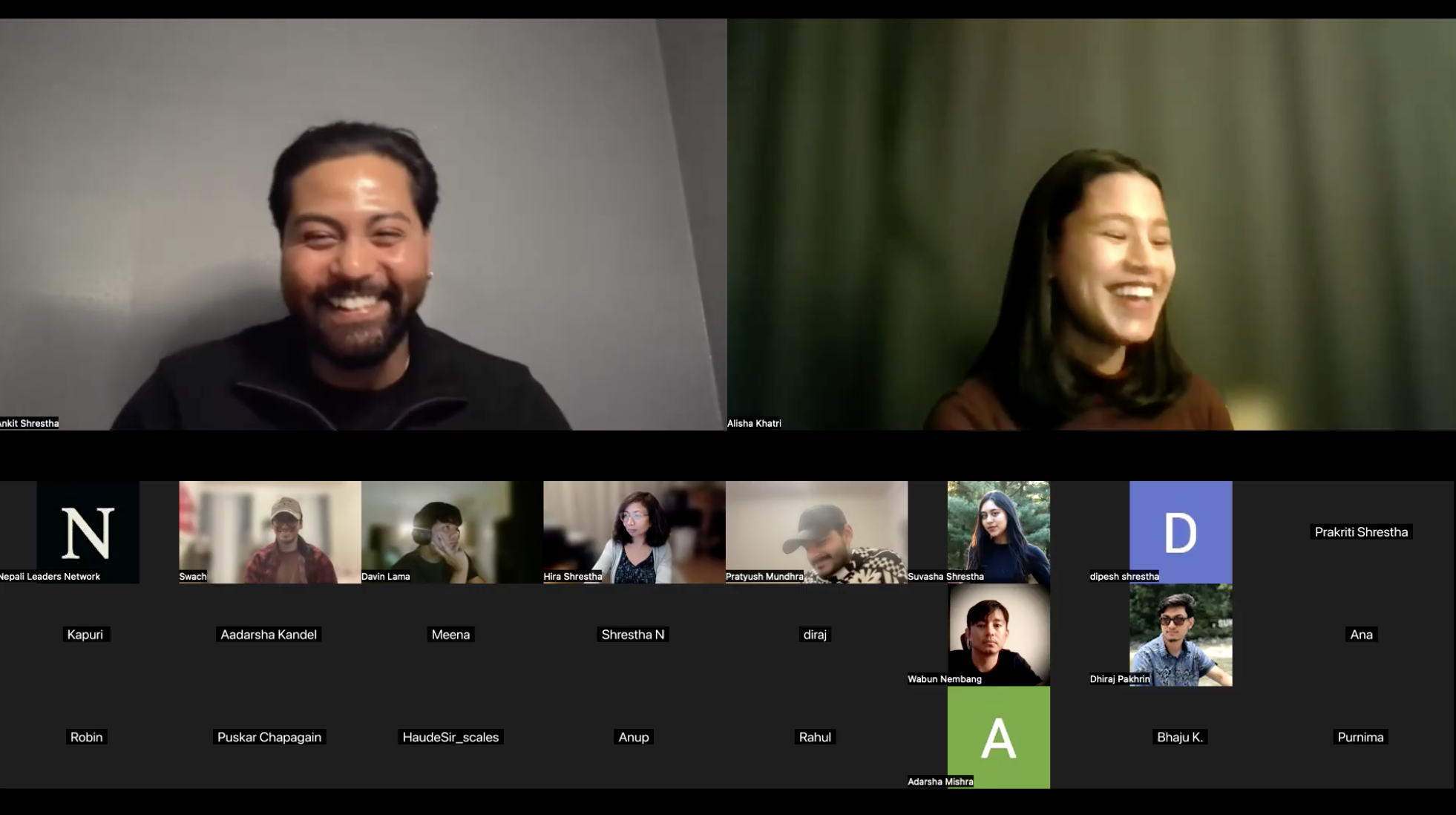
Drawing from building a $15M Amazon operation before 30, Ankit Shrestha breaks down the systems, margin discipline, and long-term decisions that quietly turn e-commerce from hype into a scalable business.
What is Amazon e-commerce really (beyond YouTube hype)?
At its core, Amazon e-commerce is simply retail, but online. You purchase products from stores or suppliers, list them on Amazon, and sell to customers nationwide. The difference is scale and logistics speed. But what most people miss is that this isn’t passive income — it’s operational intensity. You deal with inventory management, Amazon’s layered fee structure, prep requirements, shipping logistics, returns, and constant pricing shifts. If you don’t understand the backend mechanics, you don’t have a business — you have a temporary experiment.
If someone is starting from zero, what’s the smartest way to begin?
There are four primary Amazon models: Retail Arbitrage (buy in-store and resell), Online Arbitrage (buy online and resell), Wholesale (buy directly from suppliers in bulk), and Private Label (build your own brand). For beginners, Retail or Online Arbitrage is the smartest starting point because it teaches you how margins actually work, how fees impact profit, how fast products move, and how competition affects pricing — without massive upfront risk. Wholesale is where scale happens, but arbitrage is where understanding is built.
What do beginners consistently underestimate?
They underestimate profit. Buying a product for $5 and selling it for $10 is not $5 profit. You must subtract Amazon referral fees (often 8–15%), pick-and-pack fees, storage fees, shipping to fulfillment centers, prep supplies like poly bags and bubble wrap, return costs, and advertising spend. Revenue looks impressive. Margin determines survival. If you don’t calculate your real profit before purchasing inventory, you’re not operating — you’re guessing.
How do you know if a product is worth selling?
You rely on data, not intuition. Before committing capital, you analyze 30-, 60-, and 90-day pricing history, sales consistency, seller competition, and fee impact. Then you test small — typically 20 to 30 units — and let actual performance guide your next move. If it sells quickly and maintains margin, you double down. If it slows or pricing tanks, you stop buying. The goal isn’t to be right the first time — it’s to make fast, unemotional adjustments based on evidence.
What kills new sellers the fastest?
Three things: chasing viral products, overbuying inventory, and operating without systems. Viral or TikTok-driven products attract too many sellers and quickly trigger pricing wars that destroy margins. Overbuying locks up cash flow and can trigger storage penalties if inventory sits too long. And without standard operating procedures for receiving, prepping, labeling, and shipping products, the business becomes dependent on the founder’s constant involvement. As Ankit put it, “If it can’t run without you, it won’t scale beyond you.”
What mindset shift unlocked real growth?
The biggest shift was moving from chasing dopamine to playing long-term. Early revenue spikes feel exciting, but sustainable operators focus on stable demand and repeatable cash flow. Instead of trendy hype products, he leaned into everyday essentials with consistent demand. He diversified across products like a portfolio strategy — similar to the S&P 500 — so one underperformer wouldn’t sink the business. Entrepreneurship, in his words, isn’t for people chasing quick wins; it’s for those willing to build systems and think in multi-year cycles.
Key Takeaways
E-commerce is operations, not aesthetics. If you don’t understand logistics, fees, and margins, you don’t have a business.
Revenue means nothing without margin discipline. Always calculate profit after Amazon fees, shipping, prep, storage, returns, and ads.
Start simple to learn (Retail/Online Arbitrage), then scale smart (Wholesale). Education first, leverage second.
Test small. Let data decide. Double down on what works. Kill what doesn’t. Emotion is expensive.
Don’t chase trends — build stable demand. Viral products create pricing wars; essentials create cash flow.
Systems > Hustle. If the business can’t run without you, it won’t scale beyond you.
Think portfolio, not lottery ticket. Diversification protects downside and stabilizes growth.
Entrepreneurship rewards long-term operators, not dopamine chasers.
Join Our Free Community To Watch Full Talk
Upcoming Events
1. Leadership Speaker Series ft. Sudeep Regmi, Head of Data Management and Innovation, Takeda
🗓 Date: Wednesday, February 25
⏰ Time: 7:00 PM – 8:00 PM ET
📍 Location: Virtual
Sudeep will break down “How Careers Actually Grow in Tech & AI.”
What participants will learn:
- What actually separates people who grow fast vs those who stay stuck at mid-level
- The biggest career mistakes engineers and early professionals make in their first 5 years
- How AI is really used inside large companies (beyond the hype)
- When to focus on technical skills vs business impact to accelerate growth
- How leaders think differently as responsibility increases and how to start early
About Sudeep Regmi
Sudeep Regmi brings over 20 years of global leadership experience in AI, data, and enterprise transformation. He currently serves as Head of Enterprise Data Management and Innovation at Takeda, where he leads global Data & AI transformation initiatives across research, commercial, manufacturing, and corporate functions, overseeing enterprise AI platforms, responsible AI frameworks, data governance, and large-scale automation programs that drive measurable business impact worldwide.
Previously, Sudeep held senior leadership roles across medical devices and manufacturing organizations, where he led enterprise data modernization, AI-enabled platforms, cloud transformation, and advanced analytics initiatives spanning finance, supply chain, sales, and operations. Across healthcare and industrial sectors, he has built AI-ready ecosystems, modernized global digital foundations, and developed high-performing international teams.
His expertise spans enterprise AI strategy, generative and agentic AI, automation, data integration, governance, and responsible AI aligned with global regulations. He is known for translating complex technology into clear strategy and real business outcomes.
2. Leadership Speaker Series ft. Dr. Smeeta Shrestha, Research Strategist, Genomics & Human Health
🗓 Date: Wednesday, March 4
⏰ Time: 7:00 PM – 8:00 PM ET
📍 Location: VirtualDr. Smeeta will break down “How to Get Started in Research as a Student or Early-Career Professional.”
What participants will learn:
- How to take your first steps into research, even without prior experience
- How to find mentors, labs, or projects to get involved in
- What research really looks like beyond classes and textbooks
- How research skills open doors across academia, industry, and policyAbout Smeeta Shrestha
Dr. Smeeta Shrestha is a research strategist with over 20 years of experience in genomics and human health research. She has authored more than 25 peer-reviewed publications in leading journals, including Nature Genetics, Nature Communications, Clinical Epigenetics, and Microbiome, and has contributed to large international research collaborations spanning over five countries.
She currently works as a Research Strategist and was most recently a Senior Research Fellow at the Lee Kong Chian School of Medicine, where her research focused on linking gut health, metabolism, and disease using integrative genomics, transcriptomics, metabolomics, and metagenomics approaches. She has previously held academic and research positions at institutions including Nanyang Technological University (Singapore) and the Centre for Cellular and Molecular Biology (CSIR, India). Dr. Shrestha has recently joined Dhulikhel Hospital, Kathmandu University Hospital, as a molecular geneticist, with a vision to establish a medical genetics clinical service alongside teaching and research, contributing to the advancement of genomic medicine capacity in Nepal. She also brings extensive experience mentoring undergraduate and graduate students and early-career researchers across academic and translational research settings.
Behind The Scenes
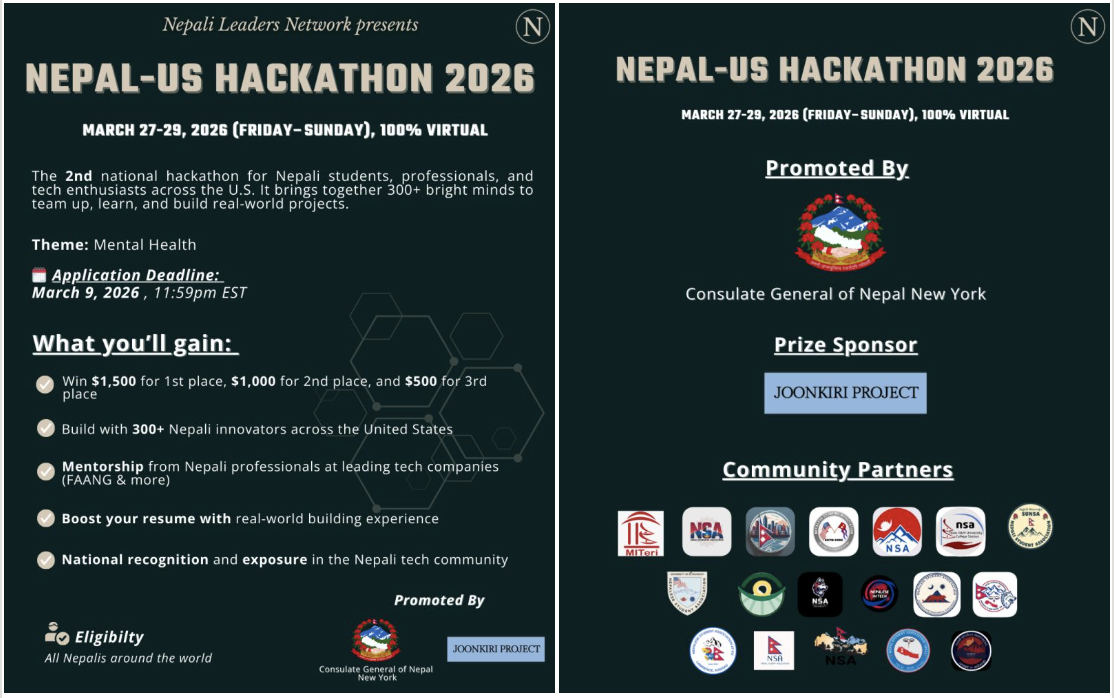
Since we launched the Nepal–US Hackathon 2026 last week…
We crossed 130+ applications from across the country.
And yesterday, we made the decision to go global.
So now if you’re Nepali (anywhere in the world), you can apply.
Also, a few updates I want you to know:
The Consulate General of Nepal in New York is officially promoting it.
The prizes are being sponsored by Joonkiri Project — an initiative focused on educational projects for young people, led by Rachana Manandhar and Sanjay Manandhar.
And now 20 organizations (including Nepali Student Associations across the U.S.) are part of this.
It’s starting to feel bigger than just an idea.
Over the next 2–3 weeks, we’ll be heads down working on all the unsexy stuff to make the experience actually good.
But while we focus on building it right…
If this sounds like something you or someone you know should be part of, apply or send it their way.
Here’s the link:
[Check out Nepal-US Hackathon 2026]
One more thing.
A lot of orgs are hosting great career, leadership, and tech-focused events and that’s a good thing. We’re planning to highlight initiatives that align with growth and building (not social events).
If you’re organizing something like that, just reply with the details & we’d love to feature it.
📌 Upcoming Event to Be Aware Of:
There will be a special screening of a documentary on Ujwal Thapa on March 1 at 3:00 PM - student tickets are $10; learn more and get tickets here:[Get Tickets].
Anyways, now that you’re officially caught up, you can check out our website to see the full breakdown of what Nepali Leaders Network is, where we’re going, and the long-term vision behind this whole thing.
And if you haven’t already,join our free community — it’s the hub for everything: events, fellowships, networking, and all the opportunities we’re rolling out next.
More soon,
Shreyas K. Shrestha
Founder, Nepali Leaders Network
P.S. If you made it this far, you’re a real one. These newsletters might be my favorite way to stay connected to 1,100+ of you. See you back in a week!
